Templon
Videos
A templon is a feature of Byzantine churches consisting of a barrier separating the nave from the sanctuary near the altar.

A Greek scaenae frons (theater screen) portraying a three-doored temple facade, posited in the early 20th century as a possible origin for the design of the templon.

Santa Maria in Cosmedin, Rome

Five-panel Deesis row, Iconostasis of the Cathedral of the Annunciation in the Moscow Kremlin by Theophanes the Greek, 1405 – the first five-row Iconostasis

A columnar templon at St Mark's Basilica, Venice
Iconostasis
Videos
In Eastern Christianity, an iconostasis is a wall of icons and religious paintings, separating the nave from the sanctuary in a church. Iconostasis also refers to a portable icon stand that can be placed anywhere within a church. The iconostasis evolved from the Byzantine templon, a process complete by the 15th century.

People's Salvation Cathedral in Bucharest (the world's largest Orthodox iconostasis)

The Temple of Saint Sava in Belgrade
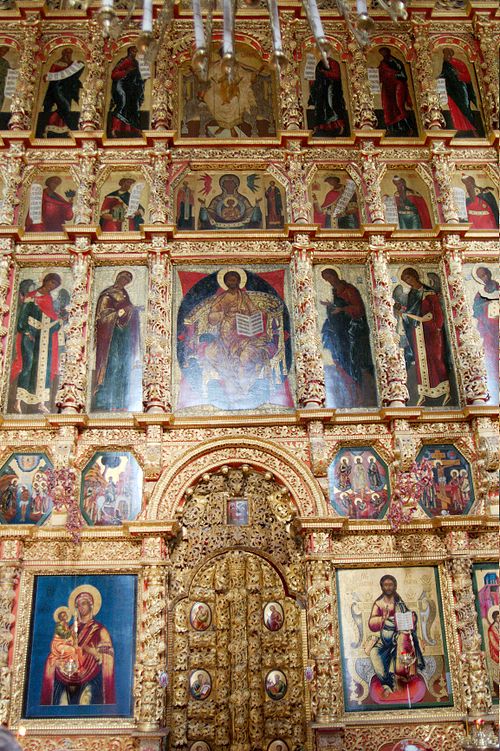
Mid-17th-century iconostasis at Ipatiev Monastery. To either side of the Holy Doors are Christ Pantokrator and the Theotokos; above them, the Great Feasts; above them, the Deesis; above that Prophets to either side of Our Lady of the Sign; above them the Apostles to either side of the Holy Trinity.