Tetrarchy
Videos
The Tetrarchy was the system instituted by Roman emperor Diocletian to govern the ancient Roman Empire by dividing it between two emperors, the augusti, and their junior colleagues and designated succ
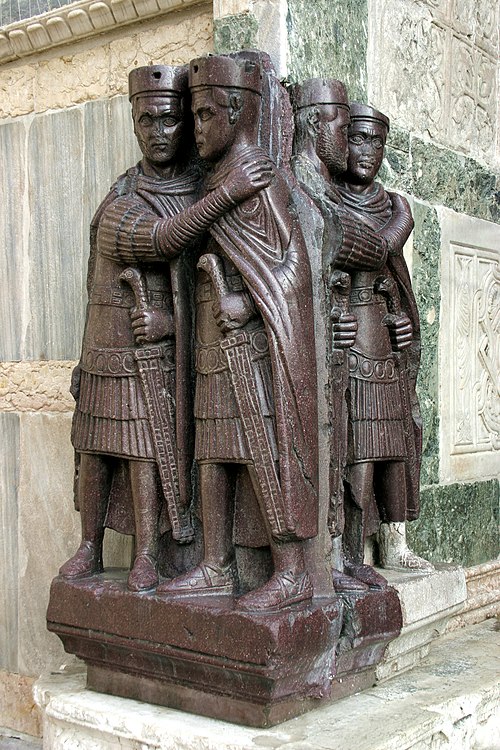
Portrait of the Four Tetrarchs, two porphyry sculptures looted from the Philadelphion of Constantinople after 1204, now standing at the southwest corner of St Mark's Basilica, Venice

On the reverse of this argenteus struck in Antioch under Constantius I, the tetrarchs offer sacrifice to celebrate a victory against the Sarmatians.

Constantine at the battle of the Milvian Bridge, fresco by Raphael, Vatican Rooms.

Istanbul Museo archeol. Diocleziano Foto G. Dall'Orto 28 5 2006
Constantius Chlorus
Videos
Marcus Flavius Valerius Constantius, also called Constantius I, was a Roman emperor from 305 to 306—and was father of Constantine the Great, the first Christian emperor of Rome. He was one of the four
Tetrarchy
…would administer the eastern ones. The role of the augustus was likened to Jupiter, while his caesar was akin to Jupiter's son Hercules. Galerius and Constantius were appointed caesares in March 293. Diocletian and Maximian retired on 1 May 305, raising Galerius and Constantius to the rank of augustus. Their…

Portrait usually identified with that of Constantius, Ny Carlsberg Glyptotek

Coin showing the Augusta Flavia Maximiana Theodora, Constantius's second wife, with the goddess Pietas on the reverse

On the reverse of this argenteus struck in Antioch under Constantius Chlorus, the tetrarchs are sacrificing to celebrate a victory against the Sarmatians.

Portrait head of Tetrarch, most likely Constantius Chlorus.