The Turkish Bath
Videos
The Turkish Bath is an oil painting by Jean-Auguste-Dominique Ingres, initially completed between 1852 and 1859, but modified in 1862. The painting depicts a group of nude women at a pool in a harem.

Le Bain Turc, by Jean Auguste Dominique Ingres, from C2RMFFXD

The original rectangular version of the painting
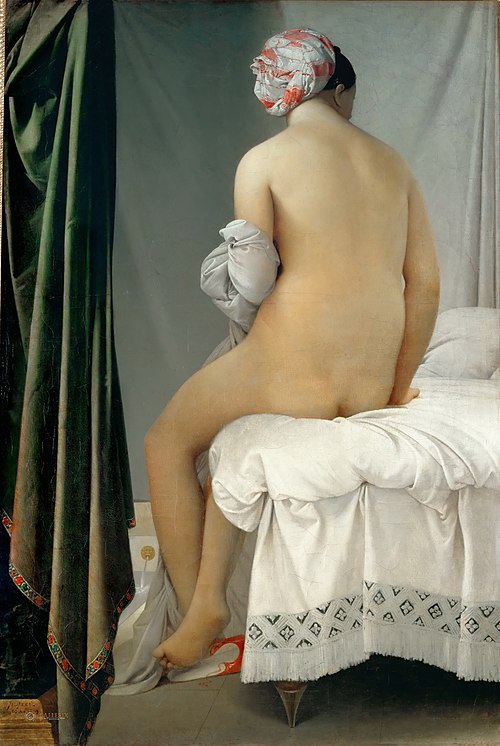
The Valpinçon Bather, 1808. Louvre, Paris.

Woman with Three Arms (Study for The Turkish Bath). Musée Ingres, Montauban.
Orientalism
Videos
In art history, literature, and cultural studies, Orientalism is the imitation or depiction of aspects of the Eastern world by writers, designers, and artists from the Western world. Orientalist paint
The Turkish Bath
…sexuality, but ultimately is intended to show Ingres's skill at defying rational perspective. Ingres was influenced by the contemporary fashion for Orientalism, relaunched by Napoleon's invasion of Egypt. On leaving for Italy in 1806, he copied into his notebooks a text extolling "the baths of the seraglio of…

Unknown Venetian artist, The Reception of the Ambassadors in Damascus, 1511, Louvre. The deer with antlers in the foreground is not known ever to have existed in the wild in Syria.

Eugène Delacroix, The Women of Algiers, 1834, the Louvre, Paris

Jean-Léon Gérôme, The Snake Charmer, c. 1879. Clark Art Institute.

Professor G. A. Wallin (1811–1852), a Finnish explorer and orientalist, who was remembered for being one of the first Europeans to study and travel in the Middle East during the 1840s. Portrait of Wallin by R. W. Ekman, 1853.