Theory of tides
Videos
The theory of tides is the application of continuum mechanics to interpret and predict the tidal deformations of planetary and satellite bodies and their atmospheres and oceans under the gravitational

High and low tide in the Bay of Fundy

A. Lunar gravitational potential: this depicts the Moon directly over 30° N (or 30° S) viewed from above the Northern Hemisphere. Note however that the moon is never more than about 28.6° north of the equator.

B. This view shows same potential from 180° from view A. Viewed from above the Northern Hemisphere. Red up, blue down.
Amphidromic point
Videos
An amphidromic point, also called a tidal node, is a geographical location where there is little or no difference in sea height between high tide and low tide; it has zero tidal amplitude for one harm
Theory of tides
…to tidal forces. Laplace's theory of ocean tides takes into account friction, resonance and natural periods of ocean basins. It predicts the large amphidromic systems in the world's ocean basins and explains the oceanic tides that are actually observed. The equilibrium theory—based on the gravitational gradient…
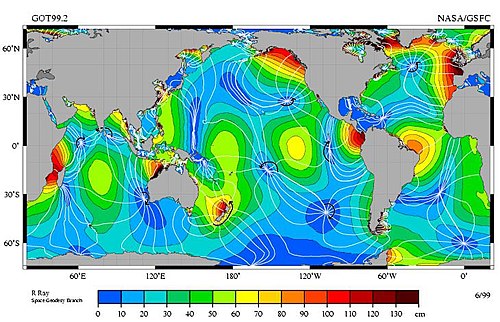
Figure 1. The M2 tidal constituent, the amplitude indicated by color. The white lines are cotidal lines spaced at phase intervals of 30° (a bit over 1 hr). The amphidromic points are the dark blue areas where the lines come together.

Figure 2. Resonance between an incident and reflected wave and the resulting total wave. At certain points (nodes), the amplitude of the incident wave and the reflected wave cancel each other out. At other points (antinodes), the amplitude of the incident wave and the reflected wave amplify each other. The respective distance between the nodes and antinodes are shown in the bottom right of the Figure and expressed in terms of wavelength.

Figure 3. Amphidromic system of the M2 constituent in the North Sea. The light-blue lines are lines of equal tidal phase for the vertical tide (surface elevation) along such a line, and the amphidromic points are denoted by 1, 2 and 3.