Titanomachy
Videos
In Greek mythology, the Titanomachy was a ten-year war fought in ancient Thessaly, consisting of most of the Titans fighting against the Olympians and their allies. The war was fought to decide which
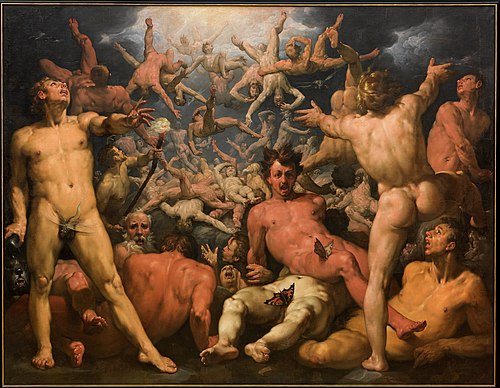
Cornelis Cornelisz van Haarlem, The Fall of the Titans, 1596–1598.

Rhea giving the rock to Cronus, 19th-century painted frieze by Karl Friedrich Schinkel.

Joachim Wtewael, The Battle Between the Gods and the Titans, oil on copper, 1600
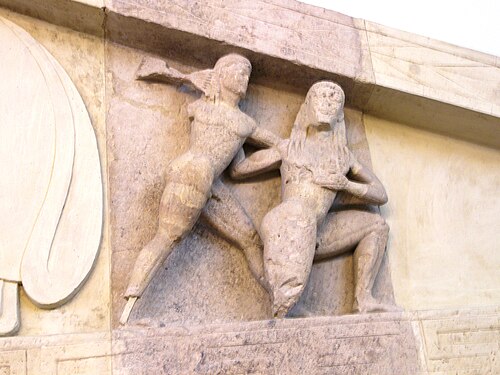
A possible Titanomachy: A beardless Zeus is depicted launching a thunderbolt against a kneeling figure (a Titan?) at the Gorgon pediment from the Temple of Artemis in Corfu as exhibited at the Archaeological Museum of Corfu.
Atlas (mythology)
Videos
In Greek mythology, Atlas is a Titan condemned to hold up the heavens or sky for eternity after the Titanomachy. Atlas also plays a role in the myths of two of the greatest Greek heroes: Heracles and
Titanomachy
…were the other Titans with the important exceptions of Themis and Prometheus (a son of Iapetus in Hesiod's version), who allied with the Olympians. Atlas, another son of Iapetus, was second in command after Cronus. The sisters Arke and Iris sided with the Olympians as their messenger goddesses, but while…

The Farnese Atlas, the oldest surviving depiction of the celestial sphere as a celestial globe.

Atlas and the Hesperides by John Singer Sargent (1925).

Herkules und Atlas by Lucas Cranach the Elder

Atlas and Heracles, metope from the temple of Zeus at Olympia.