Toga
Videos
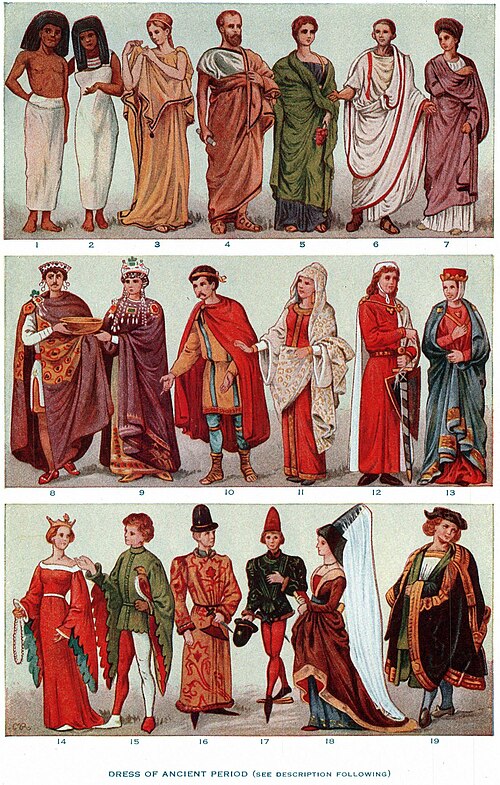
The toga, a distinctive garment of Ancient Rome, was a roughly semicircular cloth, between 12 and 20 feet in length, draped over the shoulders and around the body. It was usually woven from white wool
Statue of the Emperor Tiberius showing a draped toga of the 1st century AD


Illustration of an Etruscan wall painting from the François Tomb at Vulci. Some scholars believe this shows a toga picta, largely based on its colour and decorative detail; others suggest that the straight edges make it a Greek-style cloak, and not a toga.

A fresco from a building near Pompeii, a rare depiction of Roman men in togae praetextae with dark red borders. It dates from the early Imperial Era and probably shows an event during Compitalia, a popular street festival.

The so-called "Togatus Barberini" depicting a Roman senator with portrait busts of ancestors, one of which is supported by a herma: marble, late 1st century BC; head (not belonging): middle 1st century BC.
Stola
Videos
The stola was the traditional garment of Roman women, corresponding to the toga that was worn by men. It was also called vestis longa in Latin literary sources, pointing to its length.
Toga
…Rome's founder; it was also thought to have originally been worn by both sexes, and by the citizen-military. As Roman women gradually adopted the stola, the toga was recognized as formal wear for male Roman citizens. Women found guilty of adultery and women engaged in prostitution might have provided…

Statue of Livia Drusilla wearing a stola and palla
Clothes