Tubism
Videos
Tubisme is a term from the art world that carries two distinct meanings. On the one hand, it refers to a variant within cubism identified by art critic Louis Vauxcelles in 1911, in which artists such

Fernand Léger, The Railway Crossing, 1919, oil on canvas, 53.8 x 64.8 cm, The Art Institute of Chicago, an example of Tubism
Cubism
Videos
Cubism is an early-20th-century avant-garde art movement which began in Paris. It revolutionized painting and the visual arts, and sparked artistic innovations in music, ballet, literature, and archit
Tubism
…Tubisme is a term from the art world that carries two distinct meanings. On the one hand, it refers to a variant within cubism identified by art critic Louis Vauxcelles in 1911, in which artists such as Fernand Léger employed cylindrical, tubular, and spherical forms in vivid…

Pablo Picasso, 1910, Girl with a Mandolin (Fanny Tellier), oil on canvas, 100.3 × 73.6 cm, Museum of Modern Art, New York

Pablo Picasso, Les Demoiselles d'Avignon, 1907, considered to be a major step towards the founding of the Cubist movement

Pablo Picasso, 1909–10, Figure dans un Fauteuil (Seated Nude, Femme nue assise), oil on canvas, 92.1 × 73 cm, Tate Modern, London
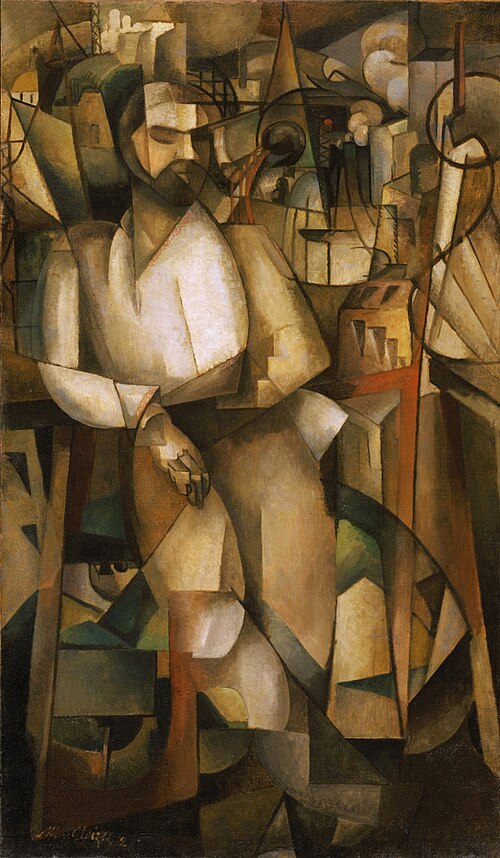
Albert Gleizes, L'Homme au Balcon, Man on a Balcony (Portrait of Dr. Théo Morinaud), 1912, oil on canvas, 195.6 × 114.9 cm (77 × 45 1/4 in.), Philadelphia Museum of Art. Completed the same year that Albert Gleizes co-authored the book Du "Cubisme" with Jean Metzinger. Exhibited at Salon d'Automne, Paris, 1912, Armory Show, New York, Chicago, Boston, 1913.