Tyari
Videos
Tyari is an Assyrian tribe and a historical district within Hakkari, Turkey. The area was traditionally divided into Upper Tyari and Lower Tyari –each consisting of several Assyrian villages. Both Upp

An Assyrian house in the Tyari, from The Assyrians and their Rituals (1852), vol. I, p. 216

"The view down stream from the mouth of the Ori valley, a little above Tal. The distant snow peak is Ghara Dagh on the southern side of Tkhuma."

Assyrian church of St. George in Lizan, Lower Tyare.

Assyrian fighter in the 1890s from the Tyari tribe.
Suret language
Videos
Suret, also known as Assyrian, is any of several varieties of Northeastern Neo-Aramaic spoken by the modern Assyrian people. The various NENA dialects descend from Old Aramaic, the lingua franca in th
Tyari
…group, along with the dialects of e.g. Tkhuma and Baz, of the Northeastern Neo-Aramaic (NENA) dialects. Like Jīlū, the Tyari dialect is a very distinct Assyrian Neo-Aramaic dialect. Unlike the Jilu, Baz and Gawar dialects (which are very similar to each other), this one is more "thick". It is, in a way, a sort of a "working…

Manishtushu Obelisk in Akkadian language (detail). The obelisk was erected by Manishtushu, son of Sargon the Great, under the Akkadian Empire in Mesopotamia (modern-day Iraq) circa 2270–2255 BCE.
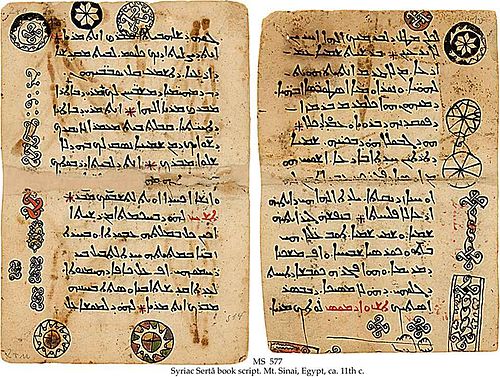
An 11th-century Classical Syriac manuscript, written in Serto script

An 18th-century gospel Book from the Urmia region of Iran

Papyrus fragment of the 9th century written in Serto variant. A passage from the Acts of the Apostles is recognizable