USS Rochester (CA-124)
Videos
The third USS Rochester, an Oregon City-class heavy cruiser, was laid down 29 May 1944 by Bethlehem Steel Co., Quincy, Massachusetts; launched 28 August 1945; sponsored by Mrs. M. Herbert Eisenhart, w

USS Rochester in February 1956

USS Rochester in 1956.

USS Rochester off Korea 1951.

USS Awatobi (YTB-264) assists USS Rochester in departing Mare Island Naval Shipyard on 20 September 1953.
Heavy cruiser
Videos
A heavy cruiser was a type of cruiser, a naval warship designed for long range and high speed, armed generally with naval guns of roughly 203 mm in calibre, whose design parameters were dictated by th
USS Rochester (CA-124)
…The third USS Rochester (CA-124), an Oregon City-class heavy cruiser, was laid down 29 May 1944 by Bethlehem Steel Co., Quincy, Massachusetts; launched 28 August 1945; sponsored by Mrs. M. Herbert Eisenhart, wife of the…

HMS Frobisher, a Hawkins-class cruiser around which the Washington Naval Treaty limits for heavy cruisers were written.
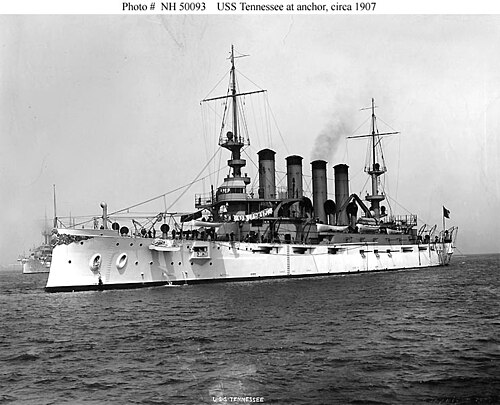
Armoured cruiser USS Tennessee (1906), armed with four 10-inch (250 mm) guns, ca. 1907

HMS Hawkins, lead ship of her class, commissioned in 1919

HMAS Canberra, a County-class "treaty cruiser".