Ultraviolet astronomy
Videos
Ultraviolet astronomy is the observation of electromagnetic radiation at ultraviolet wavelengths between approximately 10 and 320 nanometres; shorter wavelengths—higher energy photons—are studied by X
A GALEX image of the spiral galaxy Messier 81 in ultraviolet light. Credit:GALEX/NASA/JPL-Caltech.

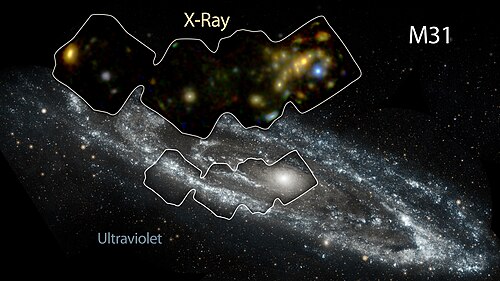
Andromeda Galaxy - in high-energy X-ray and ultraviolet light (released 5 January 2016).
International Ultraviolet Explorer was the first space observatory primarily designed to take ultraviolet spectra. The satellite was a collaborative project between NASA, the United Kingdom's Science
Ultraviolet astronomy
…Astronomical Netherlands Satellite (150-330 nm, 1974–1976) + - International Ultraviolet Explorer (115-320 nm, 1978–1996) - Astron-1 (150-350 nm, 1983–1989…

A shell of a control and display unit for the International Ultraviolet Explorer (IUE) satellite, preserved in the Steven F. Udvar-Hazy Center

The core of the science hardware of the IUE: the telescope tube and sunshade extend above the pivot point of the support stand, the cameras are just below, and some of the mirrors and diffraction gratings are at the bottom. The box extending from the midpoint of the assembly covers the location of the spacecraft gyroscopes.

Fully assembled IUE with the telescope tube on top and solar panel extended

Delta 2914 launching IUE spacecraft on 26 January 1978 from Kennedy Space Center