VO2 max
Videos
V̇O2 max is the maximum rate of oxygen consumption attainable during physical exertion. The name is derived from three abbreviations: "V̇" for volume, "O2" for oxygen, and "max" for maximum and usually

VO2 max measurement using instruments on a metabolic cart during a graded treadmill exercise test

Gas exchange of VO2 and VCO2 during max test. Begin for 3 minutes at 60 watts and add 35 watts every 3 mins until exhaustion.

A VO2 max test
Endurance
Videos
Endurance is the ability of an organism to exert itself and remain active for a long period of time, as well as its ability to resist, withstand, recover from and have immunity to trauma, wounds, or f

Twins Tashi and Nungshi Malik on an endurance trek at the foothills of the Himalayas
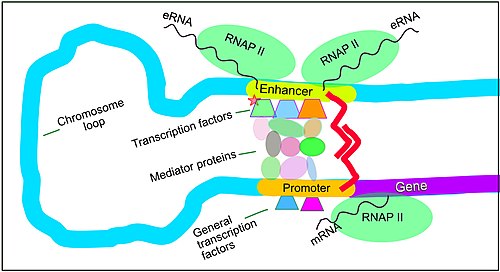
Regulation of transcription in mammals An active enhancer regulatory region is enabled to interact with the promoter region of its target gene by formation of a chromosome loop. This can allow initiation of messenger RNA (mRNA) synthesis by RNA polymerase II (RNAP II) bound to the promoter at the transcription start site of the gene. The loop is stabilized by one architectural protein anchored to the enhancer and one anchored to the promoter, and these proteins are joined together to form a dimer (red zigzags). Specific regulatory transcription factors bind to DNA sequence motifs on the enhancer. General transcription factors bind to the promoter. When a transcription factor is activated by a signal (here indicated as phosphorylation shown by a small red star on a transcription factor on the enhancer) the enhancer is activated and can now activate its target promoter. The active enhancer is transcribed on each strand of DNA in opposite directions by bound RNAP IIs. Mediator (a complex consisting of about 26 proteins in an interacting structure) communicates regulatory signals from the enhancer DNA-bound transcription factors to the promoter.

A nucleosome with histone tails set for transcriptional activation DNA in the nucleus generally consists of segments of 146 base pairs of DNA wrapped around nucleosomes connected to adjacent nucleosomes by linker DNA. Nucleosomes consist of four pairs of histone proteins in a tightly assembled core region plus up to 30% of each histone remaining in a loosely organized polypeptide tail (only one tail of each pair is shown). The pairs of histones, H2A, H2B, H3 and H4, each have