Vlachs
Videos
Vlach, also Wallachian and many other variants, is a term and exonym used from the Middle Ages until the Modern Era to designate speakers of Eastern Romance languages living in Southeast Europe—south
Théodore Valerio, 1852: Pâtre valaque de Zabalcz ("Wallachian Shepherd from Zăbalț")


Transhumance ways of the Vlach shepherds in the 18th and 19th centuries. Vlachs engaged in both transhumant pastoralism and sedentary agriculture.
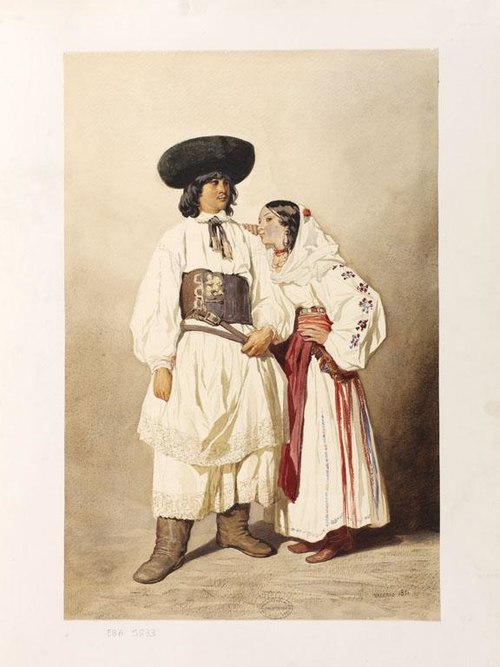
Théodore Valerio, Paysans valaques des environs de Lugos. Vlach/Romanian peasants from around Lugoj, 1851.

Vlach shepherd of Banat (Auguste Raffet, c. 1837)
Aromanian language
Videos
The Aromanian language, also known as Vlach or Macedo-Romanian, is an Eastern Romance language, similar to Megleno-Romanian, Istro-Romanian and Romanian, spoken in Southeastern Europe. Its speakers ar
Vlachs
…Although it has also been used to name present-day Romanians, the term "Vlach" today refers primarily to speakers of the Eastern Romance languages - Aromanian, Megleno-Romanian, and Istro-Romanian - who live south of the Danube, in Albania, Bulgaria, northern Greece, North Macedonia and eastern Serbia. These…

Mihail G. Boiagi's 1813 Aromanian grammar book, "Romanic or Macedono-Vlach Grammar". Written in German and Greek, it includes Aromanian texts and introduced the first writing system for Aromanian in the Latin alphabet.

Romanian schools for Aromanians and Megleno-Romanians in the Ottoman Empire (1886)

Dictionary of four Balkan languages (Greek, Aromanian, Bulgarian and Albanian), by Daniel Moscopolites