As in other pagan European cultures, wetlands and islands held a prominent position in Germanic paganism, featuring as sites of religious practice and belief from the Nordic Bronze Age until the Chris

Tissø in Zealand, which was the site of a religious centre in the Viking Age

The Trundholm sun chariot, found in the former bog of Trundholm Mose in Zealand, c. 1400 BCE, National Museum of Denmark.

Drawings of weapons found in Nydam Mose, c. 3rd-5th centuries CE

Skuldelev 2, one of a series of ships sunk to block access to the Roskilde fjord
Blót
Videos
Blót or geblōt are religious ceremonies in Germanic paganism that centred on the killing and offering of an animal to a particular being, typically followed by the communal cooking and eating of its m
The Stentoften Stone, bearing a runic inscription that likely describes a blót of nine bucks and nine stallions bringing fertility to the land.


A reconstructed Viking Age hall at the Lofotr Viking Museum in Lofoten, Norway

A drinking scene on an image stone from Gotland, Swedish Museum of National Antiquities, Stockholm
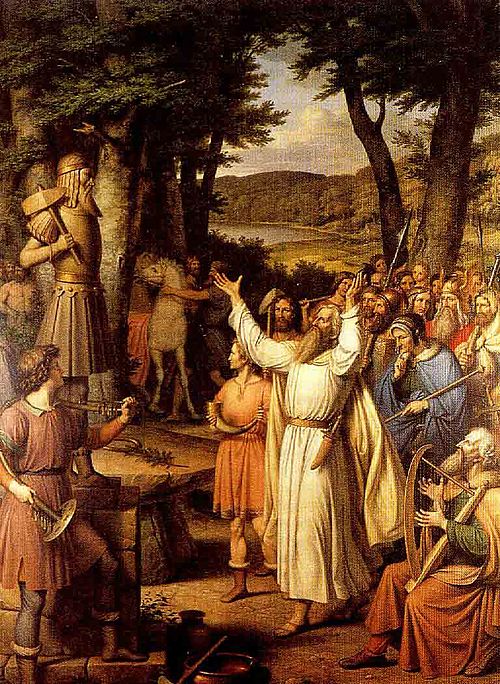
A painting of a goði leading the people in sacrificing to an idol of Thor by J. L. Lund