Wide-body aircraft
Videos
A wide-body aircraft, also known as a twin-aisle aircraft and in the largest cases as a jumbo jet, is an airliner with a fuselage wide enough to accommodate two passenger aisles with seven or more sea

A Boeing 777X. It is under testing and will be the largest twinjet, with the widest and longest fuselage to enter production.
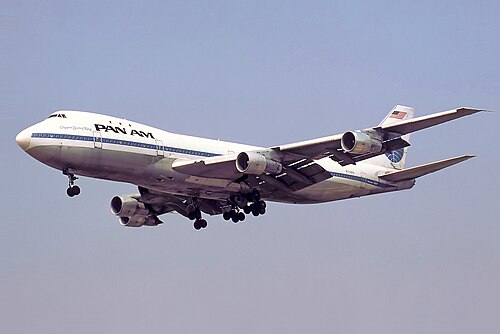
A Boeing 747-100, the first wide-body passenger aircraft, operated by Pan Am, its launch customer in 1970

Three widebodies, one in each main engine configuration: KLM's Airbus A330 twinjet, McDonnell Douglas MD-11 trijet and Boeing 747-400 quadjet

An Airbus A300's cross-section, showing cargo, passenger, and overhead areas
Narrow-body aircraft
Videos
A narrow-body aircraft or single-aisle aircraft is an airliner arranged along a single aisle, permitting up to 6-abreast seating in a cabin less than 4 metres in width. In contrast, a wide-body aircra
Wide-body aircraft
…wide-body aircraft are over 6 m (20 ft) wide, and can accommodate up to eleven passengers abreast in high-density configurations. By comparison, a typical narrow-body aircraft has a diameter of 3 to 4 m (10 to 13 ft), with a single aisle, and seats between two and six people abreast. Wide-body aircraft were originally designed…

Four-abreast cross-section

Narrow-body Airbus A320 operated by British Airways in front of a Boeing 777-300ER wide-body operated by Air Canada in June 2010

Narrow-body Boeing 737-900 operated by United Airlines in October 2010

Narrow-body Airbus A319 operated by Delta Air Lines in February 2014