Woodruff v. North Bloomfield Gravel Mining Company
The case of Woodruff v. North Bloomfield Gravel Mining Company was a lawsuit brought to California courts in 1882 where a group of local farmers sued North Bloomfield Mining and Gravel Company over damages caused to farmland in the Central Valley. The farmers who brought the suit claimed that the company's hydraulic mining operations resulted in the disposal of excess sediment, debris, and chemicals in local rivers. Prosecutors argued that the debris raised river beds and restricted flow in the rivers leading to heavy man-made flooding. In the years prior, flooding of debris and chemicals had destroyed a large portion of the valley's agriculture.
Miners using monitors to blast away hillsides in Alaska 1910. A similar process occurred in California.
Former hydraulic mining pit in Northern California. Note the physical destruction of the landscape.
Operating Hydraulic Mining elevator and impounding works at North Bloomfield Mine
Hydraulic Mining Damages in Alaska
Hydraulic mining is a form of mining that uses high-pressure jets of water to dislodge rock material or move sediment. In the placer mining of gold or tin, the resulting water-sediment slurry is directed through sluice boxes to remove the gold. It is also used in mining kaolin and coal.
A miner using a hydraulic jet to mine for gold in California, from The Century Magazine January 1883
Gold miners excavate an eroded bluff with jets of water at a placer mine in Dutch Flat, California sometime between 1857 and 1870.
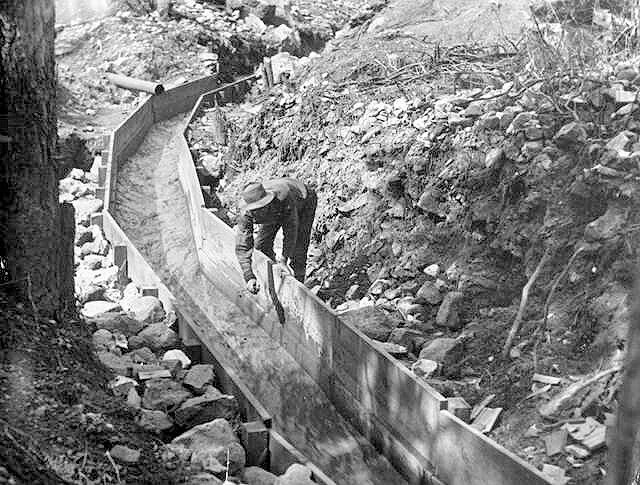
A man leans over a wooden sluice. Rocks line the outside of the wood boards that create the sluice.
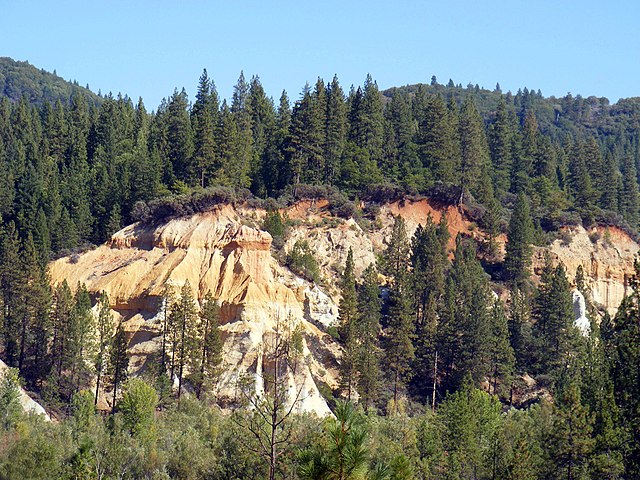
The Malakoff Diggins, California, showing the effects of hydraulic mining on a hillside over a century later. Much of the effects of the mining was beyond the hills themselves, on the areas downstream of the water and sediment flow they produced.