Wuying Pagoda
Videos
Photos
The Wuying Pagoda, also known as the Xingfu Temple Pagoda and The Thousand Year-Old Pagoda of Wuhan, is a Buddhist pagoda in Wuchang, Wuhan, Hubei Province, China. Built of stone 750 years ago during the final years of the Southern Song Dynasty, it is the oldest standing architectural feature in Wuhan. Wuying Pagoda is a Major Historical and Cultural Site Protected at the National Level.

Perspective from Northeast
Perspective from Northeast with former monument in foreground

Perspective from Southeast

Sumeru Throne (須彌座 xūmízuò), common feature of the base of Buddhist pagodas
Pagoda
Videos
Photos
A pagoda is a tiered tower with multiple eaves common to Thailand, Cambodia, Nepal, China, Japan, Korea, Myanmar, Vietnam, and other parts of Asia. Most pagodas were built to have a religious function, most often Buddhist, but sometimes Taoist, and were often located in or near viharas. The pagoda traces its origins to the stupa, while its design was developed in ancient India. Chinese pagodas are a traditional part of Chinese architecture. In addition to religious use, since ancient times Chinese pagodas have been praised for the spectacular views they offer, and many classical poems attest to the joy of scaling pagodas.

Shwedagon Pagoda of Yangon, Myanmar
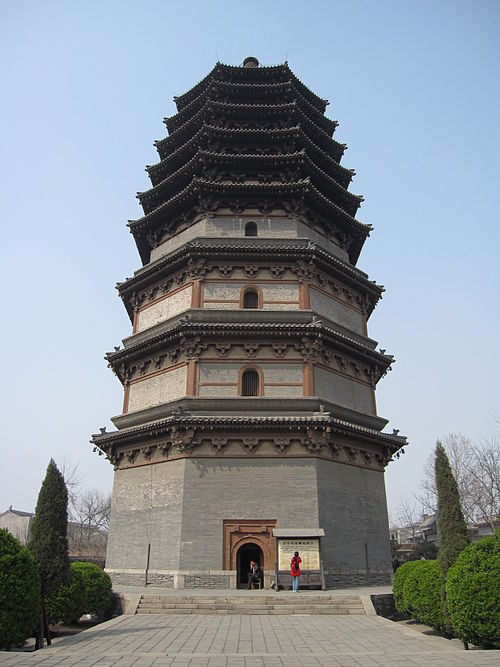
The Lingxiao Pagoda of Zhengding, Hebei, built in 1045 AD during the Song dynasty, with little change in later renovations

The Xumi Pagoda, built in 636 AD during the Tang dynasty.

Floor-support structure in a corner of the Horyuji temple.