Xenia (Greek)
Videos
Xenia is an ancient Greek concept of hospitality. It is almost always translated as 'guest-friendship' or 'ritualized friendship'. It is an institutionalized relationship rooted in generosity, gift ex

Jupiter and Mercurius in the House of Philemon and Baucis (1630–33) by the workshop of Rubens: Zeus and Hermes, testing a village's practice of hospitality, were received only by Baucis and Philemon, who were rewarded while their neighbors were punished.

A renaissance painting displaying traditional exchanges of gifts between gods. This represents the material and social exchanges involved with xenia.
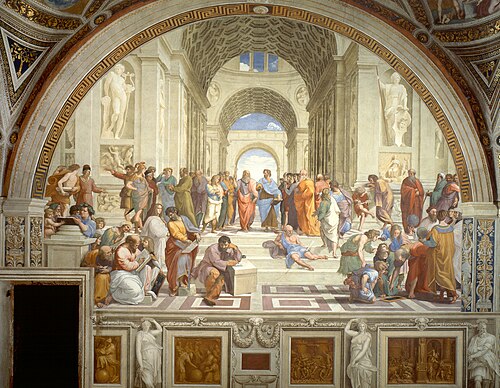
The School of Athens 1509-1511 by Raffaello Sanzio da Urbino depicts Plato discussing philosophy.

Aristippus and His Companions after Being Shipwrecked, Seeing Mathematical Diagrams, Realize the Land Was Inhabited (1726-1796 by Antiono Zucchi shows Aristippus at the shipwreck site prior to aid by the Rhodians.
Odyssey
Videos
The Odyssey is one of two major epics of ancient Greek literature attributed to Homer. It is one of the oldest surviving works of literature and remains popular with modern audiences. Like the Iliad,
Xenia (Greek)
…Hector. Instead of turning him out as the enemy, Achilles abides by the rules of xenia and allows him to stay. xenia is an important theme in Homer's Odyssey. Every household in the epic is seen alongside xenia: Odysseus' house is inhabited by suitors with demands beyond the bounds of xenia. Menelaus and…

Oldest-known manuscript fragment of the Odyssey, produced in Ptolemaic Egypt during the 3rd century BC and unearthed in Medinet Ghoram

Terracotta plaque of the Mesopotamian ogre Humbaba, believed to be a possible inspiration for the figure of Polyphemus

A mosaic depicting Odysseus, from the villa of La Olmeda, Pedrosa de la Vega, Spain, late 4th–5th centuries AD

Odysseus and his soldiers fighting the Cicones —allies of the Trojans— during the sacking of their city. After seizing goods and women, Odysseus is driven back by allies of the Cicones.