Xu Jingcheng
Videos
Photos
Xu Jingcheng was a Chinese diplomat and Qing politician supportive of the Hundred Days' Reform. He was envoy to Belgium, France, Italy, Russia, Austria, the Netherlands, and Germany for the Qing imperial court and led reforms in modernizing China's railways and public works. As a modernizer and diplomat, he protested the breaches of international law in 1900 as one of the five ministers executed during the Boxer Rebellion. In Article IIa of the Boxer Protocol of 1901, the Eight-Nation Alliance that had provided military forces successfully pressed for the rehabilitation of Xu Jingcheng by an Imperial Edict of the Qing government:Imperial Edict of the 13th February last rehabilitated the memories of Hsu Yung-yi, President of the Board of War; Li Shan, President of the Board of Works; Hsu Ching Cheng, Senior VicePresident of the Board of Civil Office; Lien Yuan, Vice-Chancellor of the Grand Council; and Yuan Chang, Vice-President of the Court of Sacrifices, who had been put to death for having protested against the outrageous breaches of international law of last year.

A photograph of Xu Jingcheng

A page from Encyclopedia of Foreign Ships by Xu Jingcheng
Boxer Rebellion
Videos
Photos
The Boxer Rebellion, also known as the Boxer Uprising or the Boxer Insurrection, was an anti-foreign, anti-imperialist, and anti-Christian uprising in North China between 1899 and 1901, towards the end of the Qing dynasty, by the Society of Righteous and Harmonious Fists, known as the "Boxers" in English due to many of its members having practised Chinese martial arts, which at the time were referred to as "Chinese boxing". It was defeated by the Eight-Nation Alliance of foreign powers.
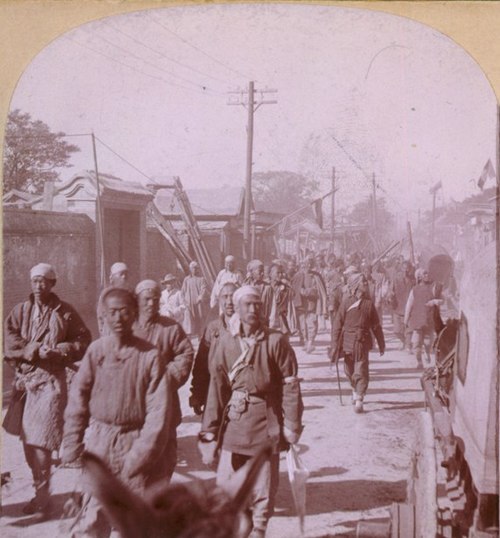
A company of Boxers in 1901
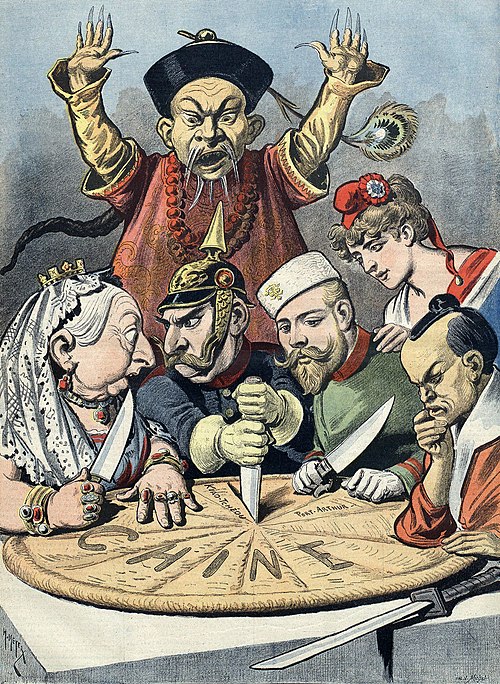
A French political propaganda cartoon depicting China as a pie about to be carved up by Queen Victoria (United Kingdom), Kaiser Wilhelm II (Germany), Tsar Nicholas II (Russia), Marianne (France) and a samurai (Japan), while Boxer leader Dong Fuxiang protests

Chinese Muslim troops from Gansu, also known as the Gansu Braves

Admiral Seymour returning to Tianjin with his wounded men on 26 June