Yusuf Khass Hajib was an 11th-century Central Asian Turkic poet, statesman, vizier, Maturidi theologian and philosopher from the city of Balasaghun, the capital of the Kara-Khanid Khanate in modern-day Kyrgyzstan. He wrote the Kutadgu Bilig and most of what is known about him, comes from his own writings in this work. He is mostly referred to as Yūsuf Balasaguni, derived from his city of origin.
As shown on the Kyrgyz 1000 som note
Mausoleum in Kashgar that was constructed for his alleged grave site
Introduction Board at Mausoleum
Portrait of Yusuf Khass Hajib at Mausoleum
The Kara-Khanid Khanate, also known as the Karakhanids, Qarakhanids, Ilek Khanids or the Afrasiabids, was a Karluk Turkic khanate that ruled Central Asia from the 9th to the early 13th century. The dynastic names of Karakhanids and Ilek Khanids refer to royal titles with Kara Khagan being the most important Turkic title up until the end of the dynasty.
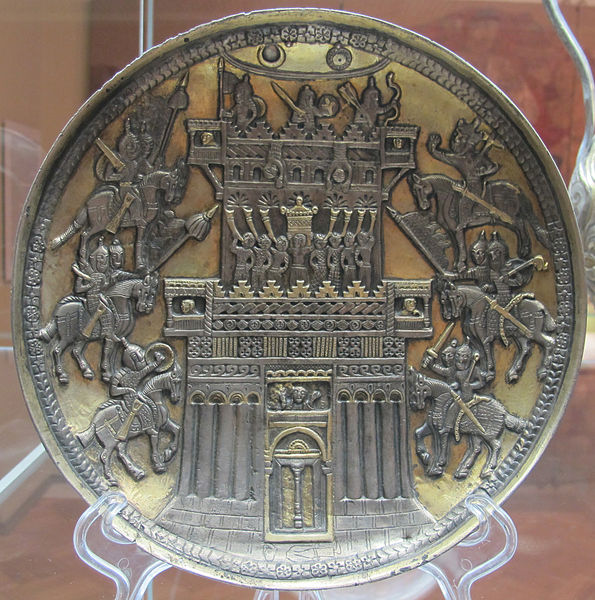
Anikova dish: Nestorian Christian plate with decoration of the Siege of Jericho, probably made by Sogdian artists under Karluk dominion, in Semirechye. Cast silver of the 9th-10th century, copied from an original 8th century plate.
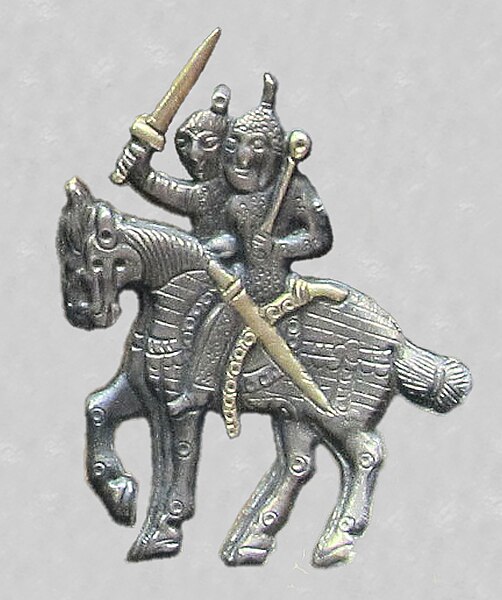
Armoured horsemen on the Anikova dish, Semirechye c. 800.
Proto-Karakhanid coinage from Semirech’e, with Arabic legend around central square hole, c. 950
Tomb of Sultan Satuq Bughra Khan (r. 920–955 CE), the first Muslim khan of the Kara-Khanids, in Artush, Xinjiang