Yngvi
Videos
Old Norse Yngvi, Old High German Ing/Ingwi and Old English Ing are names that relate to a theonym which appears to have been the older name for the god Freyr. Proto-Germanic Ingwaz was the legendary a

"Yngvi-Freyr builds the Uppsala temple" (1830) by Hugo Hamilton.
Runes
Videos
Runes are the letters in a set of related alphabets, known as rune-rows, runic alphabets or futharks, native to the Germanic peoples. Runes were primarily used to represent sound values but they were
Yngvi
…Proto-Germanic Ingwaz was the legendary ancestor of the Ingaevones, or more accurately Ingvaeones, and is also the reconstructed name of the Elder Futhark rune ᛜ and Anglo-Saxon rune ᛝ, representing ŋ. Old Norse Yngvi as well as Old High German Inguin and Old English Ingƿine are all derived from the Proto-Germanic…
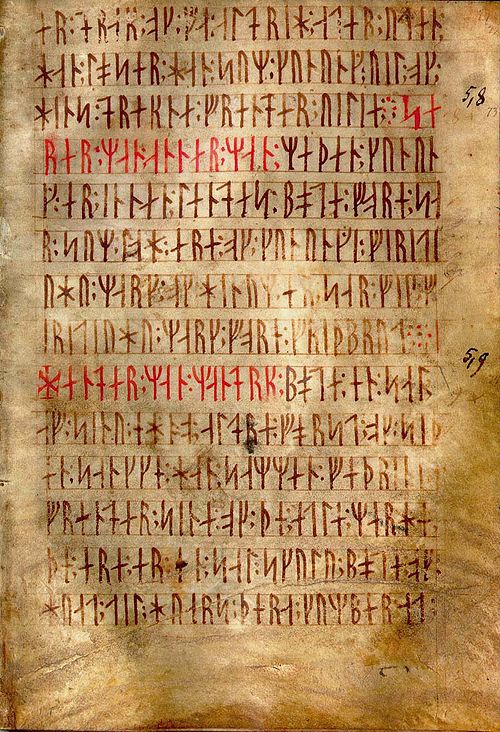
Codex Runicus c. 1300

An inscription using cipher runes, the Elder Futhark, and the Younger Futhark, on the 9th-century Rök runestone in Sweden

A Younger Futhark inscription on the 12th-century Vaksala Runestone in Sweden

Ring of Pietroassa (c. 250–400 AD) by Henri Trenk, 1875