Yugoslav Partisans
Videos
The Yugoslav Partisans, officially the National Liberation Army and Partisan Detachments of Yugoslavia was the communist-led anti-fascist resistance to the Axis powers in occupied Yugoslavia during Wo
To arms, everyone!, a Partisan propaganda poster

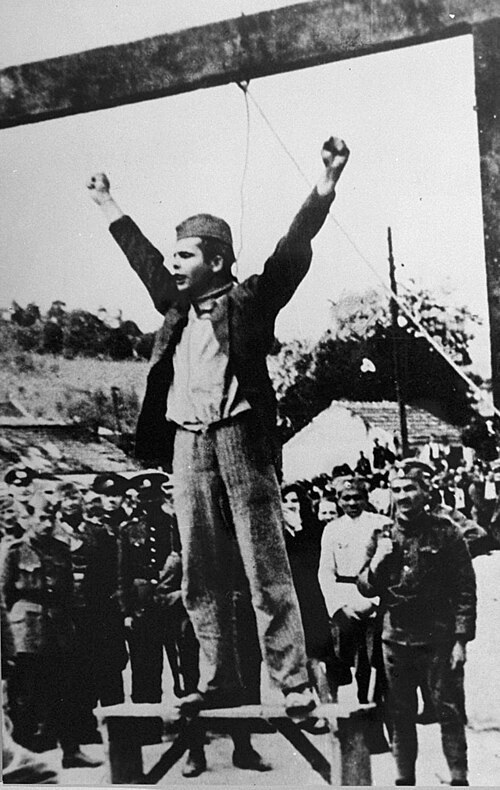
Partisan fighter Stjepan Filipović shouting "Death to fascism, freedom to the people!" seconds before his execution by a Serbian State Guard unit in Valjevo, occupied Yugoslavia. These words became the Partisan slogan afterwards.

Josip Broz Tito in Bihać, 1942

Sixteen blindfolded Partisan youth await execution by German forces in Smederevska Palanka, 20 August 1941
Independent State of Croatia
Videos
The Independent State of Croatia was a World War II–era quasi-state. It was a protectorate of Fascist Italy from 1941 to 1943, and a puppet state of Nazi Germany from 1941 to 1945. It was established
Yugoslav Partisans
…Drava Banovina (roughly modern-day Slovenia), while maintaining direct military occupation of a rump Serbian territory with a puppet government. The Independent State of Croatia (NDH) was established under German direction, which extended over much of the territory of today's Croatia and as well contained all the area of…
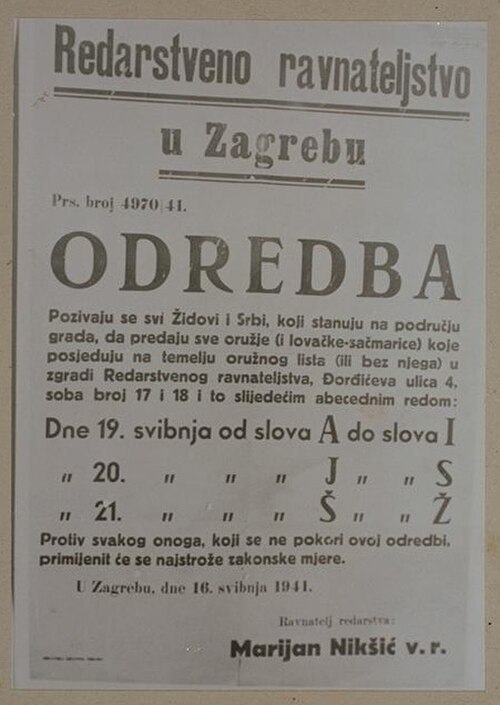
Message calling on Jews and Serbs to surrender their weapons at the risk of being severely condemned

An antisemitic poster in Zagreb, advertising an exhibition about the "destructive work of the Jews in Croatia" and the "solution to the Jewish question in the NDH."

Poglavnik Ante Pavelic (left) with Italy's Duce Benito Mussolini (right) in Rome, Italy on 18 May 1941, during the ceremony of Italy's recognition of Croatia as a sovereign state under official Italian protection, and to agree upon Croatia's borders with Italy

Adolf Hitler (left) with Ante Pavelić (right) at the Berghof, outside the Berchtesgaden, Germany