Yujia Yankou
Videos
The Yuqie Yankou rite, sometimes called the Yujia Yankou rite, is an esoteric Chinese Buddhist ritual typically performed to fulfill several different goals, including to nourish and liberate hungry g

During a Yuqie Yankou, one or more leading monk(s) take on the role of a jingang shangshi, meaning vajrācārya (金剛上師, Jīngāng Shàngshī).

Liao dynasty statue of the Eleven Headed Guanyin in Dule Temple in Tianjin, China.

A Shuilu ritual painting of the ghost king Mianran (Sanskrit: Ulkāmukha Pretarāja), which is usually displayed alongside paintings of other Buddhist divinities during Shuilu Fahui ceremonies. The portrayal of the Bodhisattva Guanyin above Mianran indicates that he is a manifestation of the Bodhisattva.

Taoist effigy of Jiaomian Dashi at a ghost festival in Taiwan. The veneration of this deity is popular in both Chinese Buddhism as well as Taoism, where he is also known as Dashiye (大士爺, Dàshìyé, lit: "Master Mahāsattva") or Puduye (普渡爺, Pǔdùyé, lit: "Master of Universal Salvation").
Chinese Esoteric Buddhism
Videos
Chinese Esoteric Buddhism refers to traditions of Tantra and Esoteric Buddhism that have flourished among the Chinese people. The Tantric masters Śubhakarasiṃha, Vajrabodhi and Amoghavajra, establishe
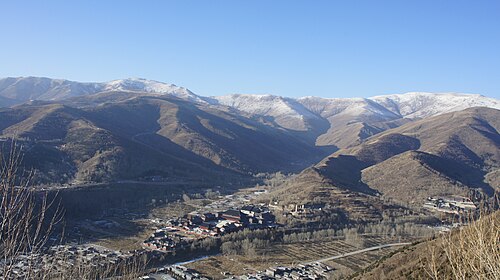
Buddhist temples at Mount Wutai

Portrait of Amoghavajra, fourteenth century, Tokyo National Museum

Mongolian Sita Mahakala (Gonggor), Erdene Zuu Monastery